***Apologies for the lack of focus***
This is a review of the Samsung Gear S3 smartwatch. I’ve only had the watch for 48 hours but wanted to get a review uploaded quickly.
One important thing that I forgot to mention in the video is that after wearing the watch for a full day yesterday there was only 15% battery left when I went to bed. This is a lot less than the 4-days mentioned by Samsung! I didn’t use the watch particularly heavily, in my opinion, as I was working. I did monitor my heart rate a few times and look at various notifications.
As I mention in the video I need to get used to using it in the gym. I need to become more familiar with the interface and perhaps configure it for my specific needs.
I had an interest experience whilst making my lunch; the watch notified my that I was doing a good job cycling… except I was mixing food in a bowl!
I also had use for the ‘find my phone’ option too: I was unpacking a box, looking for something, and when I found it I put all the contents back in the box – including my phone. So a few minutes later when I couldn’t find my phone I used the app on the watch to ping it… it worked! It would’ve taken me hours otherwise.
I’m no video producer and I don’t have the best filming kit but I hope you find the information useful nonetheless.
]]>A Nottingham man has halved his weight in just six months.
Simon Reynolds, an IT infrastructure manager in the city, went from weighing 32 stones to 15st 9lbs.
During his life changing weight loss he had the idea to create an iPhone and Android application to help others achieve their weight loss goals. As you can see in the above video Simon took a very scientific approach to his weight loss and the results speak for themselves.
]]>– How to get people to do what you want.
Preface
There are many books, and e-books, in circulation that claim to be the authority on covert hypnosis and they are the reason why I’ve decided to write this book and it’s accompanying hypnosis audio tracks.
I really wanted to know how powerful hypnosis can be in the realm outside of the therapists consultation room and reading many of the available books I was somewhat disappointed. Many of these books were just poor and offered nothing at all and many offered glimpses of genius but didn’t answer the many questions I had.
What I’ve attempted to do in this text is to bring together all of the most useful methodologies into one place so that the user has a complete framework with which to approach any situation where they wish to have the upper-hand.
Where possible I will tell the reader where I found each of the methodologies so that they may read the original text in order to gain a deeper understanding. The books mentioned herein must be considered essential reading to any of you who seriously wish to master the art of covert hypnosis.
Only once you have absorbed these methods at a deeper level and practiced them thoroughly will you really be able to exploit them.
What is covert hypnosis?
Unfortunately covert hypnosis isn’t a secret key into the workings of the military ‘Black Ops’ whereby anyone can get an unsuspecting passerby to go and kill someone else. Covert hypnosis is a little more grounded than that but it will give you the edge when someone is undecided in which route to take.
If you find yourself in a situation where you’re trying to sell something to someone else (including selling yourself) and you know they want to make the purchase but haven’t yet fully committed covert hypnosis gives you the tools by which you can help them feel good about themselves and the purchase.
Using simple tools like multiple agreement patterns you can build up the positive aspects of the decision that the subject has and decrease the negative aspects.
Covert hypnosis is utilizing the fact that most of the human race spends a lot of their time in mild hypnotic states or trance. We are bombarded with many thousands of images and stimuli throughout or normal, everyday, life and we build up filters to these stimuli so that we don’t have to give them conscious thought. When we don’t give something conscious thought we are short-cutting or automating our decision making process.
Dr Robert Cialdini calls this our ‘click-whir’ response. Think for a moment about your click-whir responses… How often do you respond to an input or stimuli in a pre-programmed way?
Dr Robert Cialdini’s superb book is a must if you’re to gain a deeper insight into the psychology of influence:
The Psychology of Influence – Dr. Robert Cialdini
Take for instance your morning routine of getting up out of bed and going to work. When your alarm goes off do you automatically lean over, switch it off, then get out of bed and make your way to the bathroom where you switch the light on and start to clean your teeth? Well, have you ever considered how far you’d get in your normal routine if someone had crept into your room in the middle of the night and changed your alarm so that it went off an hour early?
The idea of covert hypnosis is to go along with and nurture the pre-programmed responses of your target until they’re suitably compliant (without them noticing that you’re initiating their click-whir responses) and when they are you can most effectively, and artfully, so as not to set off any alarms in their minds, guide them (I don’t want to use the word coerce) into doing what you need them to do.
Another good example of covert hypnosis is when you suddenly become aware that you feel bad about a purchase you’ve made. This is called ‘buyers remorse’ and usually happens when you’ve been subtly coerced into buying something you didn’t really want or weren’t ready to buy. The sales person has used techniques which subdued your spider senses and gently guided you into making a decision in their favor. They have effectively utilized your filters and initiated your ‘click-whir’ response. It’s only once you’re mind has had a chance to go over what’s just happened that you realize you haven’t made the best of decisions and you end up plagued with feelings of regret.
Going off on a tangent slightly – there are even methods by which sales people are helping shoppers not get buyers remorse. One of my favorites is when the sales person gets the shopper to fill out the purchase requisition form themselves – this is a proven way to enforce and strengthen the shoppers’ commitment as they are signing their name to it. We’ll speak more on commitment, and how you can use it to your advantage, later.
A History of Hypnotism
To have an understanding of Covert Hypnosis it’s essential to know where the phenomena of hypnotic trance stems and how the pioneers of the field influenced the public of their time. Much of what can be done to influence another human being without their knowledge is down to their preconceptions. The less people know about a subject the more likely they are to have a misrepresentation of the facts. This information is key to your power; when you’ve discovered how much someone knows about a subject you can use your skills of manipulation to bring the results you desire. As you read this short history which follows keep this thought in-mind.
The Birth of Hypnosis
Since the beginning of time mothers have sung soothing lullabies while rocking babies in their arms. The repetitious melody and continuous motions are calming – and well ‘hypnotic’. Today we mechanize the process with rocking chairs and toys that play repetitive nursery rhymes.
Hypnosis is as old as mankind itself and even among the most ancient peoples there had been people accredited with magical healing powers. Whether such magic actually exists is open to debate. But in so fare as these people used direct commands or suggestions it can be strongly argued that what was practiced was essentially and quintessentially hypnosis in some form or other.
The first instance of hypnosis can be traced back to ancient Egypt and spread throughout Greece, Rome and Asia where hieroglyphics suggested the existence of ‘sleep temples’ where ‘priests’ would heal the afflicted.
Throughout the ages there has always been the ‘laying of hands’ where magic spells brought about a trance-like state in the people being healed.
Native Americans and some African cultures recognize the hypnotic effect of drumming and dancing which arouses the people to the point at which the conscious mind moves aside and the subconscious (unconscious) is exposed.
Self-hypnosis allows firewalkers to dissociate vital areas of the brain from the physical messages sent from the body.
The Infancy of Hypnosis
In the eighteenth century two Roman Catholic priests used hypnotic procedures and gained a reputation as healers and due to their influence on Dr Franz Anton Mesmer they played a significant role in the history of hypnosis.
Father Gassner was one of those Catholic priests. He would have those desiring to be healed brought into a room where they were told to wait. As their expectations mounted Father Gassner believed the Devil was responsible for spiritual illnesses and that exorcisms were the appropriate therapy.
Father Gassner would wait and then majestically enter the room wearing a long flowing purple cape whilst holding a huge crucifix high in the air in front of him. He would then lower his cross on to the head of the patient and command ‘Be Healed!’ The patient would then collapse and upon command would rise praising God for healing them.
Gathered around were spectators, medical students, the patients’ family and curious parishioners which made the spectacle that much more impressive but also had an affect on the patient themselves. Not wanting to fail at being healed, more than likely, had a placebo affect on the patient – this is an example of where complicity is clearly evident.
More important than perhaps the ‘cleansing’ itself was the preparation of the patient. Prior to Father Gassner’s appearance the patient was instructed:
• When you’re touched by the crucifix fall to the floor.
• Whilst lying on the floor you will die.
• You will be examined by a physician to be sure that you have no pulse and no heart sounds and then you will be declared dead.
• During your period of death Father Gassner will perform his exorcism and order the demons to leave your body.
• You will soon be revived and when you stand you will be completely cured.
And they were cured, it worked! By preparing the patient beforehand their expectations and preconceptions were configured so that they could believe nothing else but being cured.
Among the attendees at several of Father Gassner’s religious rituals was a medical student by the name of Franz Mesmer…
Father Hell was the other Catholic priest; Father Hell used hypnotic techniques and metal plates. He believed that illness occurred when the magnetism of the body was out of polarization. He would have the patient lie down and pass metal plates over them – his suggestion that the passing of the metal plates seemed to cure those whom came to him for healing.
The mystery of such practices gave way to the more plausible explanations. One of the first hypnotic healing practices came from Anton Mesmer from whom the word ‘mesmerise’ is derived. In the late 18th century Mesmer ran healing salons in Vienna and then Paris where, rather like the ancient healers, he encouraged clients to enter a trance-like state to ‘charge’ or ‘re-charge’ themselves with what he called ‘animal magnetism’ from magnetic rods immersed in a tub of water, called a ‘baquet’, complete with iron filings and glass.
NB: The word ‘animal’ in this context refers to ‘anima’ which is Latin for ‘soul’.
Mesmer had a flair for the dramatic, he would appear in flowing colored robes and his healing room would be lit in an awe-inspiring manner. A mystical atmosphere with music filled with colored smoke and many mirrors (perhaps this is where the term ‘smoke and mirrors’ is derived?) since Mesmer believed that animal magnetism could be reflected.
Again whatever the explanations for his phenomenon Mesmer was able to produce good results that substantiated his claims for cures.
Mesmers eventual downfall was that he craved recognition, not just from the masses, but also from the scientific establishment. He was widely unpopular in conventional medical circles because the growing popularity of animal magnetism was largely at the expense of more orthodox practitioners.
Mesmer then blundered badly by asking the French King for a board of inquiry. The board appointed to investigate whether animal magnetism existed included three people notable today: the pioneering chemist Lavoisier, the famous American Benjamin Franklin and a medical doctor who was an expert in paint control named Guillotin.
This committee discredited Mesmer by ruling that his successes were due to the patient’s expectation and imagination, rather than his magnetic passes, therefore mesmerism was considered a fraud.
Mesmer, thus discredited, left Paris and went back to Vienna to practice mesmerism, or animal magnetism. The notion of energy as a healing art form was left out of mainstream western medicine and psychology for a long time.
It was James Braid, an Aberdonian, in the 19th century who was largely credited with the de-mystifying of hypnosis apart from proposing more down-to-earth explanations for the phenomenon of hypnotic healing.
Braid, in 1842, coined the term ‘hypnotism’ after Hypnos the Greek God of sleep. However as he progressed in his practice and research he found that hypnosis was not a sleep stat at all and he tried to re-term it ‘mono-ideism’ (where ‘mono’ is single and ‘ideo’ is idea) which more accurately suggests the nature of a single think persisting in the mind of the person who is being hypnotized.
Not surprisingly the new name didn’t catch on since hypnosis was a lot easier to say.
James Braid induced the hypnotic state by asking people to stare at a fixed point for a few minutes. He also gave us the swinging watch method.
A few years on a surgeon by the name of James Esdaile, working in the Punjab region of India found that he could desensitize his patients against paint through the use of hypnosis. Using mesmerism Esdaile was able to carry out and document thousands of successful pain relief experiments.
He performed more than 250 operations such as amputations of the limbs and the removal of tumors and he also discovered that when mesmerized a patient to get rid of pain any redness and swelling disappeared too.
What Esdaile did and achieved was not merely as experimental exercises. The Punjab was a pretty difficult place to bring in medical supplies and thus the practice of what is now known as ‘hypno-anaesthesia’ was indeed much more of a necessity. The method might have survived had it not been for the discovery of chloroform.
Meanwhile in England another surgeon called Dr John Elliotson was doing the same thing however a medical council of the time ruled that what Elliotson did was unethical and demanded his resignation from his professional post. Elliotson introduced the stethoscope to the English Medical community.
Meanwhile in France hypnotherapy was gathering pace. Two doctors Thoedore Liebault, a country doctor, and Leopald Bernheim in Paris experimented with hypnosis in the treatment of mental conditions.
Liebault in particular often treated without charge vast numbers of the peasants of the region of Nancy (nongcie).
The two doctors became friends and effectively founded ‘The Nancy School’ (there’s a name that wouldn’t catch on today!). Liebault used calming words and a soft voice to put a patient into trance and then in a loud voice commanded that the symptoms to disappear. Often his method succeeded.
At the same time in Paris a renowned neurologist called Jean Charcot (sharcot) was making headway treating hysterical illnesses with hypnosis. He found thtat by inducing hypnosis in his patients he could get them to manifest great emotional release to the point that hysterical symptoms such as blindness, skin conditions etc. disappeared completely after treatment.
20th Century
Charcot’s work was to have an immense impact on the psychiatrist Sigmund Freud who studied hysteria under him. Freud was later to practice hypnotism in his own clinic in Vienna however, because of an unfortunate and embarrassing incident involving an over thankful female patient, who upon coming out of hypnosis, threw her arms around his neck – at the same time as Freud’s butler entered the room – Freud abandoned hypnosis and developed his own model of psychotherapy which he called ‘psychoanalysis’. However some scholars believe that the only difference in the two lies in their names.
In essence it can be argued that psychoanalysis is an example of full-awake, or conscious hypnosis.
One of the most influential figures of the 20th century came in the form of an American hypnotist called Dave Elman and the term ‘hypnotherapy’ in essence may be attributed to him.
In his 1961 book which Elman simply called ‘Hypnotherapy’ he stated that his career as a stage hypnotist helped him because of his highly effective instant hypnosis techniques. He was also a pioneer into the cognitive aspect of psychosomatic problems and as such was arguably among the first great hypnotherapists to fully acknowledge that the cure lies in the mind of the client-patient rather than the voice or hands of the hypnotherapist.
Meanwhile another great American psychiatrist called Milton Erickson (not to be confused with Erik Erikson who was a psychologist) developed his own individual model of hypnotherapy. Erickson never put his work into print because he believed that how he practiced suited only himself and would not necessarily be replicated effectively by another hypnotherapist.
Each hypnotherapist would have to find his or her own style of hypnotherapy. He also contended that every individual patient of his received an individual treatment and that no two people even with virtually identical problems were treated the same – such was the irreplaceable nature of his individualist approach.
Erickson communicated by narrating stories, inventing metaphors and recounting anecdotes. His belief was such that suggestions bypass the subject’s critical faculties and so in some instances they can avoid resistance.
As a side note, I didn’t even understand what a metaphor was until I read a description written by the autistic savant Daniel Tammet. He said:
…metaphors – a form of language where a comparison is made between two seemingly unrelated things…
This is what Erickson was getting at when he said he was trying to bypass clients critical faculties and avoid resistance. Now metaphors are a real art-form as is telling any story and therefore it is a skill well worth practicing. There are some good examples of Milton’s metaphorical tales in the book ‘My Voice Will Go With You – the teaching tales of Milton H. Erickson’ and it’s well worth a read: Amazon.co.uk: My Voice Will Go with You: Teaching Tales of Milton H. Erikson: Books: Milton H Erickson,Sidney Rosen
Erickson’s teachings inspired a great wealth of study in his wake. It is also attributed to having sparked off the Neuro-Linguistic Programming (NLP) movement.
Today there are people who use NLP not just for therapeutic purposes but also as a way of life constantly turning potential disasters into opportunities. It is also effectively used in commerce where managers and sales staff develop sophisticated mind-sets geared relentlessly towards success and goal-achievement. NLP is also gradually being filtered into educational settings.
The weapons of influence
I can guarantee that each of the following six weapons of influence have been used on you at some point in your life – either consciously or unconsciously. Even if you don’t master the use of these weapons, because mastery takes practice and some people just aren’t committed enough, you’ll be better armed at protecting yourself at those who are masters. Over time your spider senses will tingle and you’ll be able to pull back from signing that contract or buying that new washing machine.
1. Reciprocity: The Old Give and Take… and then take some more!
I didn’t even know what reciprocation meant until I started to study the laws of influence and once I did I was amazed at how often this simple rule is used by communication professionals to initiate our click-whir responses and bypass our defensive filters.
In its simplest form reciprocity is most common in modern life when dealing with charities. The Hare Krishna’s are famous for using reciprocation when attempting to get donations for their organization. Standing around in airport terminals they appear to be dishing out flowers to weary travelers just to spread some love. But their real intention is to give AND THEN receive. By giving these passersby a ‘gift’ they trigger one of the oldest known human responses – reciprocity – which is that urge you have when you’re given something that you immediately want to give something back. The Hare Krishna’s are looking for cash in return for their flower gifts – it has even been spotted that they go through the trash cans looking for discarded flowers to recycle, thus reducing their overheads.
Another old form of reciprocation that we’re all too familiar with is when the guy offers to buy the girl a drink. Every guy deep down knows that he wants something in return for that drink.
Take a few moments and think how you can subtly offer something that is unlikely to be refused and then think about how you can position what you want in return…
2. Commitment & Consistency: Hobgoblins in our mind
This is where we come back to that all important ‘yes’ response. When a sales person wants you to say yes to buying that car they don’t just wade in and ask you to sign on the line, first they ask you a series of questions that elicit a ‘yes’ response. These questions can be completely unrelated to your purchasing of a new car – the purpose of eliciting a series of ‘yes’ responses is to get the potential customer (or conquest) to set up a pattern: after saying ‘yes’ three times most people will be ready to reply ‘yes’ to the forth question.
Another good example of commitment and consistency is seen at the race track. Psychologists have observed that punters are a lot more committed to the horse or dog that they’ve backed after they’ve placed the bet.
So going back to the car sales person analogy you can see why they ask questions like
So, you’ve got a family? You’re going to want a car that’s practical but also safe?
Another great example is that of an experiment staged on a New York City beach to see if onlookers would risk personal injury to stop a crime. In the experiment, a research accomplice would put a beach towel down five feet from the towel of a randomly chosen individual – who would be the experimental subject. After a couple of minutes spent relaxing on the towel and listening to music on an MP3 player, the accomplice would stand up and leave the towel to stroll down the beach. A few minutes later, a second researcher, pretending to be a thief, would approach, grab the MP3 player, and try to run off with it. As you might guess, under normal conditions, subjects were very reluctant to put themselves in harm’s way by challenging the thief – only four people did so in the twenty times the theft was staged. But when the same procedure was tried another twenty times, with a slight twist, the results were drastically different. In these attempts, before taking his stroll, the accomplice would simply ask the subject to please watch my things, which each of them agreed to do. Now, propelled by the rule for consistency, nineteen of the twenty subjects became virtual vigilantes, running after stopping the thief, demanding an explanation, and often restraining the thief physically or snatching the MP3 player away.
Take a few moments and think how you could get your targets commitment and then take that forward to test how consistent they are…
3. Social Proof: Using the team to support
The famous quote from Walter Lippmann is a good place to start when discussing social proof:
Where all think alike, no one thinks very much.
If you’re in a situation where you’re surrounded by a group of likeminded people you’re more likely to make choices based on what the rest of the crowd are doing.
Social proof is a phenomenon that’s exploited my communicators everywhere; one common example which we’ve all come into contact with is canned laughter. As you’ve sat and watched your favorite situation comedy the only time you notice the laughter track it surely felt like an annoyance and you probably wished that it wasn’t included. But it has been proven time and again that people find comedy funnier when the laughter track is included.
The reason why canned laughter works is because we all like to feel that we belong. When our friends and family tell us that we must watch the latest sit com because it’s so funny we naturally want to be a part of that and don’t want to be left out. The laughter track is initiating the same programming – one of the basic human needs is to belong – so we join in with the laughter and laugh along. Below is a diagram depicting psychologist Abraham Maslow’s ‘Hierarchy of needs’ in which you can clearly see the layer describing how the basic human need of ‘belonging’ forms a platform for the higher needs:
Come back to the above diagram when planning for influence. It provides a matrix which provides the building blocks. If you start at convincing your target that they belong you can then move up the matrix to the other layers. You should internalize this diagram as it is very useful for planning a path to your desired outcomes.
When it comes to finding illustrations of the strength of social proof, there’s one that is far and away my favorite. It shows how social evidence can be used on us – not by others, but by ourselves – to assure us that what we prefer to be true will seem to be true.
The story is an old one, requiring an examination of ancient data, for the past is dotted with millennial religious movements. Various sects and cults have prophesied that on one or another particular date there would arrive a period of redemption and great happiness for those who believed in the group’s teachings. In each instance it has been predicted that the beginning of the time of salvation would be marked by an important and undeniable event, usually the cataclysmic end of the world. Of course, these predictions have invariably proved false. To the acute dismay of the members of such groups, the end has never appeared as scheduled.
But immediately following the obvious failure of the prophecy, history records an enigmatic pattern. Rather than disbanding in disillusion, the cultists often become strengthened in their convictions. Such is the strength of social proof, along with the other great weapon of influence we’ve already talked about: Commitment & Consistency.
In the book ‘The Venutian Arts Handbook’ Mystery (aka Erik Von Markovik) states that people tend to form social alignments with one another, wherever such alignments benefit their chances of survival and replication – there are two lower levels in the hierarchy that state we need to both survive and replicate – for example, a primitive tribe is a form of social alignment. Those within the tribe have improved chances of survival they wouldn’t normally have if they were alone.
If you’d like to learn a little more about Mystery and his ilk a truly wonderful book is The Game by Neil Strauss: The Game – Neil Strauss
Another example of alignment is a modern-day celebrity entourage. Entourage members enjoy increased access to sex. Even though the entourage member is not a celebrity, he has still improved his survival and replication value through his association with the celebrity (gaining social proof).
Being aware of this weapon of influence is enough to enable your own early warning system. By giving yourself a split second to think and thus circumnavigate your click-whir response you will be able to avoid following the other lemmings off the cliff.
Taking this awareness a little further you can train yourself to see when others are susceptible to following the pack and use the situation to your advantage.
Take a moment and think for a while on the times when you’ve fallen into this trap and how someone may have taken advantage of you. Then turn these thoughts around and think how you could have taken advantage of the situation.
4. Everyone likes me: The friendly thief
The main work of a trial attorney is to make a jury like his client. Clarence Darrow.
Few people will be surprised to learn that, as a rule, we most prefer to say yes to the requests of someone we know and like.
NB: The above sentence is mostly true except for new research into the sexual habits of men that are anti-social. It is evident that a man that appears brash and confident to the extent of becoming arrogant will have more sexual partners. You’ve probably seen the men that don’t look away when they’ve been caught leering across the bar – these men will continue to hold eye contact. This is alpha male behavior and it attracts women who are looking for physical contact.
Getting back to the liking rule the most obvious exploitation of this technique are Tupperware and Mary Kay parties. Knowing how powerful this weapon of influence is has been used by these sales organizations because they know how we’re all obliged to buy the products to support our friends.
Similarity is another click-whir initiating stimulus. Not only do we make assumptions about people who like us – we make assumptions about people that are similar to us. Similarity can be looks, stature, financial status or beliefs. In order to utilize this weapon of influence you should appear as similar as possible to your potential target.
Take a moment to think of a time that you did something because a friend asked you to. Think about how you’ve wanted to help someone because you liked them – think about how this may have happened to you and you can’t really put your finger on the reason why you liked this person or that you didn’t really know them that well.
Again you now have the awareness of this weapon which will not only help you to protect yourself against its power but you have the enlightenment that will enable you to use this for your own gain.
5. Authority: Yes of course Doctor!
Most people are aware that a title has a profound effect on how we behave and we barely question the statements of those in white coats carrying clipboards. But is this wise? Again we’re initiating our bypass programming to get a quick and easy result or we’re deferring responsibility.
The famous experiment carried out by Professor Stanley Milgram in the 1960’s is a perfect illustration of the power of authority. After initial greetings and pleasantries are exchanged, the researcher begins to explain the procedures to be followed. He says that the experiment is a study of how punishment affects learning and memory. Therefore, one participant will have the task of learning pairs of words in a long list until each pair can be recalled perfectly; this person is to be called the Learner. The other participant’s job will be to test the Learner’s memory and to deliver increasingly strong electric shocks for every mistake; this person will be designated the Teacher.
Naturally, you get a bit nervous at this news. And your apprehension increases when, after drawing lots with your partner, you find that you are assigned the Learner role. You hadn’t expected the possibility of pain as part of the study, so you briefly consider leaving. But no, you think there’s plenty of time for that if need be and, besides, how strong a shock could it be?
After you’ve had a chance to study the list of word pairs, the researcher straps you into a chair and, with the Teacher looking on, attaches electrodes to our arm. More worried now about the effect of the shock, you inquire into its severity. The researcher’s response is hardly comforting; he says that although the shocks can be extremely painful, they will cause you no permanent tissue damage. With that, the researcher and the Teacher leave you alone and go to the next room, where the Teacher asks you the test questions through an intercom and delivers electric punishment for every wrong response.
As the test proceeds, you quickly recognize the pattern that the Teacher follows. He asks the question and waits for your answer over the intercom. Whenever you err, he announces the voltage of the shock you are about to receive and pulls a level to deliver the punishment. The most troubling thing is that with each error you make, the shock increases by 15 volts.
The first part of the test progresses smoothly. The shocks are annoying but tolerable. Later on, though, as your mistakes accumulate and the shock voltages climb, the punishment begins to hurt enough to disrupt your concentration, which leads to more errors and ever more disruptive shocks. At the 75-, 90-, and 105-volt levels, the pain makes you grunt audibly. At 120 volts, you exclaim into the intercom that the shocks are really starting to hurt. You take one more punishment with a groan and decide that you can’t take much more pain. After the Teacher delivers the 150-volt shock, you shout back into the intercom, That’s all! Get me outta here! Get me outta here!
But instead of the assurance you expect from the Teacher that he and the researcher are coming to release you, the Teacher merely gives you the next test question to answer. Surprised and confused, you mumble the first answer to come into your head. It’s wrong, of course, and the Teacher delivers a 165-volt shock. You scream at the Teacher, to let you out. But he responds only with the next test question – and with the next slashing shock when your frenzied answer is incorrect. You can’t hold down the panic any longer; the shocks are so strong now they make you writhe and shriek. You kick the wall, demand to be released, beg the Teacher to help you. But the test questions continue as before and so do the dreaded shocks – in searing jolts of 195, 210, 225, 240, 255, 270, 285 and 300 volts. You realize that you can’t possibly answer the test correctly now, so you shout to the Teacher that you won’t answer his questions any longer. Nothing changes; the Teacher interprets your failure to respond as an incorrect response and sends another bolt. The ordeal continues in this way until, finally, the power of the shocks stuns you into near paralysis. You can no longer cry out, no longer struggle. You can only feel each terrible electric bite. Perhaps, you think, this total inactivity will cause the Teacher to stop. There can be no reason to continue this experiment. But he proceeds relentlessly, calling out the test questions, announcing the horrid shock levels (about 400 volts now), and pulling the levers. What must this man be like? You wonder in confusion. Why doesn’t he help me? Why won’t he stop?
For most of us the above scenario reads like a bad dream. But all becomes clear when you realize that all the participants are actors apart from the guy sending the shocks.
The whole purpose of the experiment was to find out how far a person would follow orders. The results of this test proved that most people were willing to deliver fatal electric shocks because they believed they were participating in an important experiment organized by a prominent professor.
Take a moment to think about a time when you, maybe blindly, followed the orders of a prominent authority figure…
Now you’re armed with an awareness of this weapon of influence you can protect yourself against blindly following orders from authority figures. You now also have the knowledge that if you elevate your level of authority you can have the power to influence.
6. Scarcity: The rule of the few.
Collectors of everything from baseball cards to antiques are keenly aware of the influence of the scarcity principle in determining the worth of an item. As a rule, if it is rare or becoming rare, it is more valuable.
Sales people are all too aware of the scarcity principle. How many times have you gone into a store looking for a particular product only to be told that the one on display is the last one in the store – only then the salesperson says they’ll just check out the back to make sure. This tactic heightens your desire for the product and will probably enable your click-whirr response into buying the product immediately without further thinking it through.
As children we too felt the scarcity principle when our parents said we couldn’t have that one toy or we couldn’t go to that one place – what happens when these restrictions are placed upon us? Well, we just want them even more. The fact that these liberties have become scarce just means they’re more valuable.
Now that you’re aware of the scarcity principle and how it’s probably something that you’ve had personal experience with imagine for a moment how you can now use this weapon to get people to do what you want…
What products or services do you offer that could become limited in number or time dependent?
Imagine that you’re in a taxi rank waiting with a potential partner – there’s only one taxi and you live in opposite directions… How would you use this situation to your advantage?
Presuppositions
A presupposition is an assumption or premise or a speculation of something supposed without proof. If I say, My cat is the smartest cat on earth, you might begin to argue with me. You might argue that other cats are smarter. You might argue that there is no way for me to determine that my cat is the most intelligent. You would unlikely argue the presupposition that I have a cat! Why? Because you have to think about me having a cat in order to make sense of the statement.
In other words, the assumption of me having a cat has gone right past conscious awareness and has been accepted without question. Well, that’s what we want suggestions to do – go to the unconscious mind.
So, what we don’t want questioned, we use as a presupposition. The listener is less likely to question the presupposition. If they question anything, it will likely be the focus of the statement, not the presupposition.
There are several different categories of presupposition, temporal (including temporal verbs and adverbs and subordinate clauses of time), adverb and adjective presuppositions, ordinal numeral presuppositions, the illusion of choice patterns, awareness predicates and commentary adjectives and adverbs.
Other examples of presuppositions are (just to labor the point):
Do you want to do it again?
Here the presupposition is that you’ve done it already, at least once.
My wife is pregnant.
Here the presupposition is that the speaker has a wife.
Now, before we dive in to the different types of presuppositions let us first discuss why they’re so important.
Because the life of the average human is chaotic in that we’re bombarded with thousands of different messages everyday it is imperative that we learn to filter that which is, and is not, important to us. Our filters are built up from our experiences and beliefs and they enable us to create short-cuts to making decisions.
One of the tenets of NLP (Neuro-Linguistic Programming) is The map is not the territory. Quite simply this is why presuppositions work: people’s views of the world do not accurately reflect the territory because of the aforementioned filters that we all build up through our experiences and beliefs.
As a powerful communicator this is an important tool that you can utilize in order to get people to do what you ask or indeed it can be used to get people to believe that they had the idea in the first place (surely this is the pinnacle of communication for the speaker of the message holds no responsibility for the act that has been initiated?). The following subsections describe in detail how you can use presuppositions to your benefit.
Temporal Presuppositions
Example Language:
As you sit there you can begin to go into trance. You can continue to relax during the process of the trance deepening.
Explanation:
Temporal means of time. Temporal presuppositions use time. If you say Buckle up when you drive this car off the lot, the presupposition is that you’ll drive the car off the lot. But the focus of the statement is buckling up. The drive the car off the lot statement may slip under the radar.
In the above statement the hypnotist starts by stating truth – in the present tense – he says As you sit there which elicits a yes response if the client is already compliant. Getting a yes response from a compliant client (or target) the hypnotist then is more likely to get them to follow the subsequent command you can begin to go into trance.
The second part of the above statement starts with a presupposition You can continue to relax… The presupposition being that the client is already relaxing. The presupposition is then followed by another presupposition during the process of the trance deepening. Here the assumption is that they’re already in a trance and that we’re continuing to deepen.
There are two types of Temporal Presuppositions, Subordinate Clauses of Time and Change of Time Verbs and Adverbs. It’s not really important to go into the differences in grammar between the two; you’ll get how to use them from the examples.
To Practice This Pattern:
1. Think of an outcome – something you want to do.
2. Think of how you would tell them directly to perform the action (let’s say go into trance).
3. Add a temporal word or phrase (As you go into trance or continue to go into trance).
Temporal Word or Phrase Examples (Subordinate Clauses of Time):
As, when, while, during, at some point in, at the same time as, at that point in time, concurrently, alongside, in tandem with, whenever, before, after, since, once, until, as long as, previous to, subsequent to…
Temporal Word or Phrase Examples (Change of Time Verbs and Adverbs):
Begin, start, commence, initiate, stop, bring to an end, halt, cease, proceed, continue, yet, still…
These patterns becomes particularly powerful when combine Subordinate Clauses of Time and Change of Time Verbs and Adverbs. As you go into trance but before you enter trance completely, continue to relax further while your mind grows more calm and peaceful.
Presuppositions: The Illusion of Choice
Example Language: (asking someone out on a date)
Would you like to go to a movie or meet for a coffee?
Explanation:
The Illusion of Choice Milton Model pattern has a person choose between two or more alternatives, all of which lead to your outcome. The presupposition is that they achieve the outcome.
The example above presupposes that the target wants to go out. It doesn’t leave the target with any easy escape route by which to get out of going on a date!
If your goal is for them to enter trance you might ask Would you like to enter trance in the blue chair or on the couch? The choice then becomes, not whether or not to enter trance but where.
You can soften this pattern by adding that they can accomplish the goal (whatever it is) in their own way. What would you like to do? Would you prefer to complete the report based on the template I’ve provided you, the template that the accounting department uses or do you want to create the report in your own format?
Use the word or to generate this pattern.
To Practice this Pattern:
1. Think of an outcome – something you want someone to do.
2. Think of two or more ways they could accomplish the outcome.
3. Lay out all the options and ask them which they would prefer.
Presuppositions: Adverbs and Adjectives
Example Language:
Are you deeply curious about how much you’ve learned?
Explanation:
Adverbs and adjectives are words that are used to describe (illustrate) other words. They can also be used to create presuppositions.
Here’s an example… In the sentence how quickly did he run, run is the verb, quickly is an adverb – it describes how he ran. Once again, the presupposition goes right past the conscious mind. The presupposition is that he ran at all!
Pay attention and play with word order. I don’t know how easily you can learn, is much better than I don’t know how you can learn easily.
These patterns can be softened by asking questions. Are you deeply in trance, might get a no response but it still allows for the possibility of being in trance (No I’m not deeply in trance, I’m in a light trance.) If you make the statement you are deeply in trance and they disagree you’ve lost rapport.
To Practice This Pattern:
1. Think of an outcome – something you want someone to do (or believe).
2. Form a sentence with that goal in it (let’s say learn a lot).
3. Add an adverb or adjective to describe one of the words in the sentence (I don’t know if you’re aware how easily you can learn a lot.)
Commentary Adjectives and Adverbs:
Adjectives and adverbs such as fortunately and necessarily are called Commentary Adjectives and Adverbs. They presuppose everything in a statement after them. Fortunately, bringing about this kind of change is easy, is a much easier statement to accept than bringing about this kind of change is easy.
These patterns become particularly powerful when you stack them. As you quickly and easily go into a powerful trance you may consider how the dynamic and practical learnings can instantly and wonderfully, create profound and insightful internal peace. Luckily, this peace lasts a lifetime.
What the Dentist Taught me about Hypnosis
I went to the dentist yesterday and it was amazing how quickly I zoned out in the chair. It got me thinking about it… What is it about the dentist that zoned me out so quickly and what is it we can learn from that that can help us to hypnotize ourselves and others more effectively?
Embedded Suggestions
Example Language:
If you can find the opportunity to LEARN THIS material THOROUGHLY, you might find that it helps you to FEEL GOOD.
Explanation:
Embedded Suggestions are simply suggestions that are buried inside other communications. You can think of them as coded messages. The unconscious mind is very good at picking up patterns. The conscious mind focuses on the surface message and your unconscious picks up the pattern of the messages hidden inside.
In the example given above, the embedded message is ‘learn this thoroughly, feel good’. This message is marked out (in this case) by being presented in capitals. Embedded suggestions work best in short, simple 1, 2 or 3 word fragments such as learn now, or relax deeply.
In order for the unconscious to pick up a pattern you must consistently mark out messages in a particular way. You can change the volume or tone of your voice. You can change your body position. You can gesture to a particular place. You can change the rhythm or speed of your speech. You can pause. In written form, you can put embeds in italics or a different font or size or colour. Just do it consistently.
I like to add a slight pause before and after my embeds as well as change the rate of speech (I slow down) slightly during the embedded suggestions.
Many people find a way to (slight pause)… relax… deeply (slight pause) while sitting in that very chair.
To practice this pattern:
1. Think of an outcome (something you want someone to accomplish).
2. Think of how you’d ask them to do it directly.
3. Practice working those words into a conversation and marking them out.
No of course you must try to not sound like a recording and be at all consciously formulaic in your approaches. If at any moment your target suspects that they’re being played or that your approach sounds scripted then they’re not going to like or respect you and their defenses will be raised even if they don’t consciously know what’s going on.
Non-threatening approaches such as those discussed in Neil Strauss’ brilliant book ‘The Game’ are what you should be attempting. For a sales assistant to be able to approach a person browsing in their shop whilst they’re wearing the stores logo across their chest is actually very difficult. Unless the person browsing the store is there on a mission to buy something specific their defenses are going to go up as soon as they see the assistant smiling over at them. Already in the shoppers mind they are formulating a response which probably goes something like this:
No, I’m fine thanks, I’m just browsing.
Now, for instance, say that the first time the shopper sees the sales assistant he’s paying no attention to the shopper but is struggling to see something that appears more interesting outside the store. Hurrying over to the doors that the shopper has just appeared through the sales assistant looks over at the shopper almost as though he’s only just seen him. The sales assistant now says something like:
‘Hi, did you see that Porsche out there? Wow, that’s some car. I dream of having a car like that! Do you like Porsches?’
And, hopefully, if the shopper hasn’t read this or other works on covert hypnosis he’s probably just going to reply with a ‘yes’ or ‘no’. If he’s feeling particularly comfortable in this situation he may well expand upon his answer by saying:
‘Yeah I love Porsches, apart from that stupid ugly 4×4 they’ve built!’
And that’s your first ‘yes’ response. Immediately, as a young Jedi out to master the art of covert hypnosis, that should be your signal (as the sales assistant) to line up another series of questions where you can guarantee more ‘yes’ responses. Once you’ve had enough positive responses and you feel you can lead the conversation you can then the questions you’re really interested in.
An example of how a man can use this technique with a woman is to exchange the Porsche for a really badly dressed woman and the conversation can start with the man grimacing about how he thought it was an ex-girlfriend and how badly dressed she was! Instantly, the guy gets an opportunity to give the woman a ‘neg’ by saying that she’s wearing the same dress or shoes.
Non-verbal Communication
Much has been said and written about body language and other non-verbal communication but it must be acknowledged that this is an art-form rather than an exact science. When ‘people watching’ it is important to look for clusters of movements rather than specific individual movements. For instance we all know that someone touching their nose or lips is a sign that they’re lying, right? Well actually no, they may just have an itch or be feeling self conscious.
When trying to ascertain whether someone is lying it is important to ask them questions to which you know they won’t lie and then ask some questions to which you know they’ll lie. This way you’ll notice patterns emerging and then when you’ve discovered that particular individual’s pattern you can ask the really important questions to which you need to know whether they’re lying or not. The break from the subjects preferred pattern will give you your answer as to whether or not they’re lying.
Derren Brown has some very interesting views on hypnosis and indeed body-language and his book ‘Trick of the Mind’ is an absolute must read if you’re to become a master persuader: Derren Brown – Tricks of the Mind
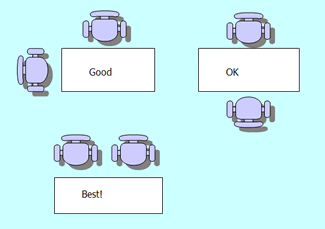
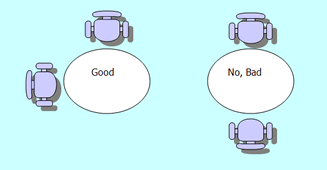
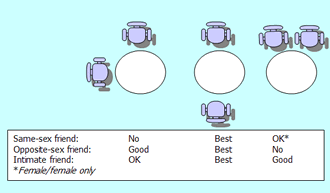
Kevin Hogan has done some interesting work on non-verbal communication and how to get the best out of seating arrangements when seeking different kinds of cooperation. Following are some seating plans and how you’re best positioned (literally) to be persuasive:
For rectangular tables if you seek conversation, compare the following layouts:
If you seek cooperation consider the following layouts:
For square or round tables – if you seek conversation or cooperation:
In a bar or nightclub with same-sex friend / opposite-sex friend / intimate friend:
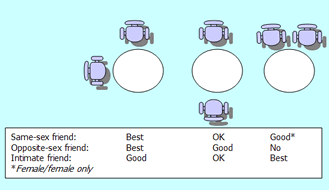
In a restaurant with same-sex friend / opposite-sex friend / intimate friend:
Something that too many people overlook is personal space here are some rough guidelines:
1. Intimate space 0-18 inches
2. Casual-personal space 1.5 feet-4 feet
3. Social consultative space 4 feet-12 feet
4. Public space 12 feet-limit
Check out Kevin Hogan’s ‘The Psychology of Persuasion’ for more of these gems: Kevin Hogan – The Psychology of Persuasion
Eye Accessing Queues
This is probably the most talked about part of NLP. It was once said that our ‘eyes are the windows to our souls’ and that’s very true but with the earlier caveat about how you much watch for clusters of movements and recurring patterns – once you’ve learnt how a person normally responds you are better armed to figure out when or if they’re lying.
The basic rules are as follows but remember that these are for right-handed people – left-handed people are likely to be the opposite (this is as you’re looking at someone face-on):
Visually Constructed Eyes go up and to the left
Visually Remembered Eyes go up and to the right
Auditory Constructed Eyes go straight to the right
Auditory Remembered Eyes go straight to the left
Kinesthetic (Touch) Eyes go down and to the left
Auditory Digital (Internal Diaglog) Eyes go down and to the right
A word on Ross Jeffries
Ross Jeffries is a hero in the mastery of picking up women and was one of the original Pick Up Artists (PUA’s) to teach his skills in seminars and workshops.
I first saw Ross Jeffries in a BBC television production by Louis Theroux called ‘Weird Weekends’ which was an enlightening journey into American subcultures. In one episode titled ‘Hypnosis’ Louis had a one-on-one session with Ross Jeffries on how to pick up women – or as he calls it ‘connecting with them on a deeper level’.
Below is a transcript of the actual dialog between Ross Jeffries (RJ) and his target that he just spotted sitting outside a bar – I consider this dialog pure genius and there’s much to be learned from it – watch out for the use of body-language on Ross’s part and the use of hypnotic language:
RJ: “Oh you’re from the midwest?”
Target: “How could you tell?”
RJ: “You’re from Chicago or Wisconsin?”
Target: “I’m from Detroit”
RJ: “Detroit, well close.”
RJ: “First of my name’s Ross.” (puts hand out to shake)
Target: “I’m Jen”
RJ: “Let me tell you something about yourself
you make imagery in your mind
very very vivid, you’re a very vivid daydreamer
..and in fact you’re smiling because you know I’m right!
you can look at someone and they think you’re listening
usually you are listening but
you’re bored and you can be looking right at them
even though you’re looking right at this person [pointing two fingers towards his own eyes]
you could be… a million.. miles… away
in you favorite, ideal, fantasy vacation spot
…true?”
Target: “You’re right!”
Target: “How do you know that?”
RJ: “I do a very rare, very unusual – hardly anyone knows about it – it’s a form of
hypnosis that involves no sleep
none. I call it blissnosis”
RJ: “Did I undertand you on a much deeper level than most people?”
Target: “Yeah I felt it.”
RJ: “Yeah, and you know what? You know that feeling
right.. [stroking finger up the ladies arm from just above the elbow]
better… better… even better right now..”
Target: “Oh yeah!”
RJ: “Yeah the more you focus in the more intense the feeling”
RJ: “Did that feel good?”
This weeks training is the one I’ve probably been looking forward to more than any other as it’s covering two of my favorite subjects: Ericksonian techniques and Neuro-linguistic Programming (NLP).
Although there has been much talk about NLP and its achievements there has also been somewhat of a backlash because of its many unsubstantiated claims. This has led me to read more about the subject in order to gain a balanced view. NLP is a pseudo-science because nothing in its research can be verified or substantiated because of the non-scientific and sensationalist way it has been performed.
The following is an interesting excerpt from the Wikipedia entry on Hypnotherapy, Erickson and NLP:
“Milton H. Erickson, M.D. is considered one of the most influential modern hypnotherapists. He has written many books, journals and articles on the subject, and his accomplishments are well-documented.
During the 1960s, Erickson was responsible for popularizing an entirely new branch of hypnotherapy, which we now call Ericksonian hypnotherapy, characterized by, amongst other things, indirect suggestion, confusion techniques, and double binds.
The popularity of Erickson’s techniques has since led to the development of neuro-linguistic programming (NLP), which has in turn found use in modern-day sales, advertising, and corporate training. However, NLP has been criticised by many eminent hypnotists as a distortion of Erickson’s work. For example, Andre Weitzenhoffer, a leading Stanford researcher and former colleague of Erickson, complained,
[…] Richard Bandler and John Grinder [the founders of NLP] have on the other hand, offered a much adulterated, and at times fanciful, version of what they perceived Erickson as saying or doing guided by their own personal theorising. (Weitzenhoffer, The Practice of Hypnotism, 2000: 592-593) “
But to the contrary many aspects of NLP do work because they are processes and patterns that have been derived from the very therapists its originators, Richard Bandler et al, were studying. Many of these patterns and therapeutic processes have also turned up in the mainstream and more accepted therapies such as Cognitive Behavioral Therapy (NLP)
Milton Erickson’s very basic fundamental approach was one of utilization; meaning that he would use, for the objective of therapy, everything and anything the client bought with them. Erickson would also use everything in the environment to aid in therapy and trance induction including unavoidable distractions.
Erickson is also famous for his use of metaphors which is a form of language where a comparison is made between two seemingly unrelated things. In the book “My voice will go with you – The Teaching Tales of Milton H. Erickson” there are many wonderful and often strange tales that almost appear to have nothing to do with therapy. Many of us have watched a film and in the first instance only been aware of the story at a conscious level. Then after a period of time our unconscious mind has had time to process other hidden meanings. Disney films are especially filled with glorious metaphors.
We studied Erickson’s script ‘Early Learning Set’ this week and I’m reading through it again now. It’s not a very long script but it takes you to many different places by engaging your imagination to travel back in time to when you’re young and then to a special place (“…now you can go anywhere you want…”) and then the imagery of water. Then you’re bought back into your own body where you analyze how your eyes, breathing and pulse feel. It’s a wonderfully dreamy script that enables the client to realize how easy it is to learn and re-learn.
The use of metaphors are an excellent approach when dealing with some forms of resistance. Some clients, especially children, may not want to talk openly about certain painful experiences. By using indirect suggestion hidden within metaphors this can be overcome.
We were given cards on which fictional clients described their issues and we were asked to write a metaphor. Mine is below:
Client: Male, ‘can’t switch off’. He feels overloaded and he can’t sleep. He likes swimming, fishing and walking in the open countryside.
I attempted an Ericksonian-like metaphor:
My friend John loves walking in the countryside, especially when he finds undue pressure constantly gnawing at him. The autumn is his favorite season. He finds that he’s stressed right up until the moment he parks his car and switches off his engine where he makes a transition into a calm and relaxed state. As he gets his fishing equipment out of the car and closes the boot on his weekly troubles he is then able to lose himself in the beauty of the surrounding countryside.
As he casts his fishing rod out into the clear blue water he is able to sit back and relax deeply. He’s so relaxed that it feels like he’s in a trance. And he can let his mind gently drift. Allowing all tensions and worries to drift and dissipate.
And although he’s completely relaxed he’s aware when a fish tugs on the line. And gently reeling in the fish in before releasing it he takes in the beauty of the fish which brings deep satisfaction.
This whole experience makes him realize how these fishing trips are so important to maintaining his balance in life. Upon returning from each trip he’s then able to drift into a deep and relaxing sleep.
It is my belief that at least some of the subjects who talk about past-lives or imaginary fantasy are in fact telling us a story of themselves and this is the only way they have to do it which leads me on to another interesting form of metaphor, The Reverse Metaphor. This is where you can get the client to tell the story.
I tried this with my step-daughter with encouraging results. I had her imagine a corridor with three doors, as in the example script we were given, and then had her walk through one of the doors. She found herself in a room she described as an old-fashioned study with many interesting books on dinosaurs and an old grand father clock. She found this room to be very interesting and described it as restful. I left her with the post-hypnotic suggestion that she could return here whenever she felt stressed or needed to relax.
This in itself didn’t give any clues to underlying issues but it did formulate a place where she could feel comfortable. When dealing with sensitive and often painful memories under trance it is imperative that some groundwork is done beforehand and this is an ideal situation which could be utilized. When performing a ‘this life’ regression, for example, the client can be comforted by the fact that they can retreat at any time back to this ‘special place’.
NLP
We had Shaun Brookhouse and Fiona Biddle take the NLP part of the course which was quite entertaining. Taking on the persona of Richard Bandler himself Shaun systematically found a way to offend nearly every person in the room. I understand that there’s a way of thinking which believes you learn better when you’re in an uncomfortable state so perhaps that was his underlying intention.
The definition of NLP is a difficult one to comprehend but I like the brief synopsis given in our notes:
Neuro: The nervous system (the mind), through which our experience is processed via the five senses:
• Visual
• Auditory
• Kinesthetic
• Olfactory
• Gustatory
Each person will favor one, or a few, of these. This is what’s implied in NLP as a preferential reference system.
Linguistic: Language and other non-verbal communication systems through which our neural representations are coded, ordered and given meaning. These include:
• Pictures
• Sounds
• Feelings
• Tastes
• Smells
• Words (self talk)
For me, this is where the famous quote “the map is NOT the territory” comes from. We all process information in different ways this is why we all experience things differently.
Programming: The ability to discover and utilize the programs that we run (our communication to ourselves and others) in our neurological systems to achieve our specific and desired outcomes.
So, in conclusion NLP is understanding how our own internal programming works to interpret our experiences. Once you understand how this works within you, you can change it.
In today’s culture we are bombarded with about two-million bits of information every second and so in order to function we need a method to cope and the way we do this is to delete what we don’t think is relevant, distort what we believe we already know and generalize by grouping similar things together.
In other words we process information by filtering it through our previous life experiences our values and beliefs.
This gives us a picture of each experience that is unique to us.
Sometimes just gaining an understanding of how we filter this information is enough to provoke a change.
The Presuppositions of NLP
1. Have respect for the other person’s model of the world by understanding that their view has been created from their experiences, values and beliefs.
2. Behavior and change are to be evaluated in terms of context and ecology i.e. is it a good thing for this person to have this behavior in this situation – it’s good to be afraid of fire if your house is burning down!
3. Resistance in a client is a sign of a lack of rapport. There are no resistant clients, only inflexible communicators. Effective communicators accept and utilize (Erickson again) all communication presented to them.
4. People are not their behaviors – Accept the person; change the behavior.
5. Everyone is doing the best they can with the resources they have available. Behavior is geared for adaptation, and present behavior is the best choice available. Every behavior is motivated by a positive intent. Ask the client: what is it they’re getting from their negative behavior?
6. Calibrate on behavior: the most important information about a person is that person’s behavior i.e. watch what they do!
7. The map is not the territory. The words we use are NOT the event or item they represent because they’ve been translated through our filters.
8. You are in charge of your mind and therefore your results. And I am in charge of my mind and therefore my results.
9. People have all the resources they need to succeed and to achieve their desired outcomes. There are no un-resourceful people, only un-resourceful states.
10. All procedures should increase ‘wholeness’. The client should have a greater inner rapport and feel aligned with that.
11. There is only feedback! There is no failure, only feedback.
12. The meaning of communication is the response you get.
13. The law of requisite variety: The system/person with the most flexibility of behavior will control the system.
14. All procedures should be designed to increase choice – except for procrastinators, they need less choice!
Observing other people – Sensory Acuity
When building rapport and being able to read the client correctly it is imperative that you not only listen to what they’re telling you verbally but be able to ‘see’ what they’re telling you with their physiology. Being able to spot incongruence between these to channels will enable the therapist to understand the situation more fully.
Communication is:
7% Words – what you’re saying
38% Tonality – the way you’re saying it
55% Physiology – what you body is saying
The following is a simple, non-inclusive guide, to developing your sensory acuity:
1. Skin Color: Light ? ? Dark
2. Skin Tonus (the tone of the muscles): Shiny ? ? Matt
3. Breathing – Fast or Slow & High or Low
4. Lower lip size and shape: Lines ? ? No Lines
5. Eyes – Focused or Defocused & Pupils: Dilated or Un-dilated
NLP makes a lot of noise about eye accessing queues and although they’re not an absolute rule (they don’t work for everyone) they’re very useful to understand: Derren Brown does a wonderful piece where he is able to tell when someone is lying and he uses this extensively but it’s important to note that he’s picking out the behavior that’s different from the norm rather than sticking to strict rules.
When attempting to read body language, and that includes eye accessing queues, it’s important to look at clusters of movements and not individual movements themselves – if someone scratches their nose it’s probably because they have an itch and they’re not necessarily lying.
Modalities and Sub-Modalities
A modality is a combination of sub-modalities that make up a behavior of a specific experience. Each sub-modality is a thought, feeling or image and once put together make the experience as that person sees or feels it.
The Meta-Model
The meta-model of NLP is a heuristic (“any method found through discovery and observation”) questions designed to specify information, challenge and expand the limits to a person’s model of the world.
It responds to the clients’ deletions, generalizations and distortions by directly challenging them.
Interestingly this is perceived as the opposite of the Milton-model of therapy which uses artfully vague language patterns to illicit change.
NLP Fast Phobia Cure
I’m currently working with a client who has a fear of flying and confined spaces as well as a fear of driving in traffic. Although I’ve yet to find the incident that heralds the beginning of these experiences I have found and amended a copy of the NLP Fast Phobia Cure to use as a framework for dealing with each of these:
Step One: I want you to imagine that at the cinema and you’re sitting in a movie theatre. Take a moment to look around the theatre, notice the décor and what the seats are like and look back for a moment to where the projection booth is…
Now on the screen you will see a black and white still photograph of yourself – a snapshot – showing you before you had the experience the film is going to show.
In a moment the screen is going to show a film about you…
This film will be in black and white with no sound. The film will be of poor quality and shaky, like an amateur filmed it, with a hand-held camera. The image may flicker.
But before the film starts, I want you to float up out of your body and into the projection booth behind you, from where you can control the film. And as you’re up there in the projection booth, with those enormous reels of film on the projector and that long beam of white light streaming towards the screen, I want you to notice [clients name] sitting there in her seat waiting for the movie to start.
And now I want you to start the projector and to watch [clients name] as she sits in her seat down there in the theatre and watches the movie of you going through [the traumatic experience]…
After the client has watched the movie through in this detached state ask the following questions:
So how was it when you watched that film?
If the client answers “I felt a little afraid” or something similar then ask “Did you remember to stay back in your seat in the movie theatre, or did you actually become involved in the movie itself?”
Step two: Have the client step into the movie at the end when the experience is over and she’s safe (all the dangers have gone). Now, with the traumatic part over, she sees things through her own eyes just as if she were actually there. Things are in color and three-dimensional.
And then have her very, very fast rewind the whole experience to the very beginning, like the film is being played backwards, with all the people walking backwards and everything in reverse.
And then have her fast-forward the film and then rewind it again. And when she can rewind the whole experience in about one second, have her repeat that five or ten times.
Step three:
Now I want you to imagine that you’re going through [the traumatic experience] again. What does that feel like for you now as you look back on that experience?